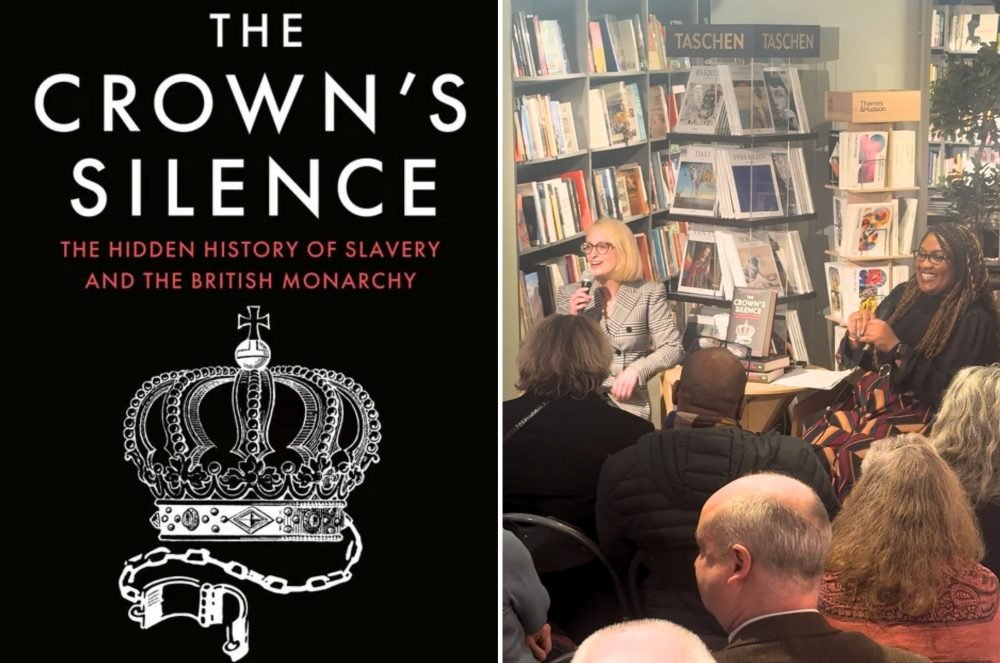
I recently finished ‘The Crown’s Silence: the hidden history of slavery and the British Monarchy‘, penned by Dr Brooke N Newman on the intimate and lengthy – but little discussed – relationship the British Monarchy had to the transatlantic slave trade.
★★★★☆
‘A deeply researched and important book that was hugely educational and connected dots in my historic knowledge.’
This forensic examination of the Monarchy’s entanglement with slavery is an educational and sometimes uncomfortable read. I think it a book worthy of a place on anyone’s bookshelf who has a passing interest in royal, British or colonial history, to begin some important conversations…
What is The Crown’s Silence about?
‘The Crown’s Silence: the hidden history of slavery and the British Monarchy‘ interrogates the relationship between the British Crown and the slave trade from the late fifteenth century through to the eighteenth and nineteenth centuries, abolition, and into the modern day approach of today’s King Charles III.
It uses contemporary evidence from a wealth of sources to build this chronological narrative.
While it is immensely interesting, it is not comfortable reading. Nor should it be.
What I enjoyed about The Crown’s Silence
For those of us who have not formally studied slavery (yes really – while slavery is on the British curriculum when I was in high school, it was not a compulsory topic), the book is very informative. It demonstrates the lengths to which British Kings and Queens had been passive investors, vocal supporters and even defenders of various companies and later simply the state, in the undertaking of the slave trade.
For example, as early as 1481, I learnt, English venturers were heading to West Africa to attempt to exploit its wealth, but that it was Elizabeth I who committed to official support of trafficking humans across the Atlantic ocean.
By the later 17th century, the slave trade and the plantations they staffed meant that sugar and tobacco customs duties accounted for roughly a third of Crown revenue, while their success created a bubble for the South Sea Company, which eventually popped. It caused large-scale economic panic and the company to tank, as people speculated on slavery and lost much money.
I was unaware that Oliver Cromwell was responsible for the conquest of Jamaica, and that the word ‘guinea’ for coinage (20 shillings or £1) derived from gold coins embossed with an elephant, struck with metal secured by the Guinea Company.
What this book also did particularly well for me, is connect seemingly separate moments in early modern British and European history.
The dowry of Catherine of Braganza – Charles II’s Queen – included the ports of Tangier and Bombay (modern day Mumbai). But it wasn’t until Dr Newman discussed the difficulties of maintaining the north African outpost that I realised why these were part of the dowry: they were so valuable.
Of course I knew of the Boston Tea Party and that it happened because of taxes – but not that the taxes were seen as necessary to impose on the self-governing colonies to support the ballooning cost of the British empire: patrolling waters, and maintaining forts and fleets.
The book also highlights that women were central to the abolitionist movement. Former slaves and campaigners petitioned royal women such as Queen Charlotte and Princess Caroline of Brunswick to aid their cause, while sugar boycotts and mass petitioning kept the topic of emancipation and on the Commons’.
For those of us who have not formally studied slavery (yes really – while slavery is on the British curriculum when I was in high school, it was not a compulsory topic), the book is very informative. It demonstrates the lengths to which British Kings and Queens had been passive investors, vocal supporters and even defenders of various companies and later simply the state, in the undertaking of the slave trade.
We are reminded, too, of the moral inconsistencies within the royal house itself: William IV, having visited Jamaica as a young naval officer, was strongly pro–slave trade. In contrast, the younger George III expressed moral unease in the writings of his youth.
And the complexity of the topic matter is stark. Enslaved people were legally defined as property with the 1677 Navigation Act, yet this ‘property’ could commit crimes and be prosecuted. The sheer administrative and legal contortions required to sustain a system so cruel and unnatural are laid bare.
On a separate note, while a trade book, The Crown’s Silence started to pick at some of the nuanced debates of the era, such as gender roles in King- and Queenship and the values they were expected to hold, which I would love to see taken up by other scholars.
Where I wanted more
If I have a critique, it is one of context and scale.
There were moments where I wanted modern equivalents or clearer quantification. Historic prices are cited, such as the £200,000 spent on tobacco per year, in the reign of James I, but prices in particular are not translated into something a 21st century reader can immediately grasp.
I read about a ‘steady stream of Africans’ entering Britain. But are we talking 50 a year, or 500? Similarly, runaway slave adverts appearing ‘with increasing frequency’ in London newspapers after 1660 – but is this twice a month, or twice a day? I would have understood the situation at home better, and how the marginalised, but free, men and women were living and participating in society.
While of course a book needs clear parameters, the Palatinate crisis of the 1620s is referenced as part of the reason the national mood shifted, but feels brushed over, despite being a pivotal European flashpoint. A paragraph to explain this could have helped, since it isn’t a hugely well-known event.
And I felt that the – admittedly distant but debated – possibility of Queen Charlotte having mixed-race ancestry is not explored, despite its symbolic weight in a conversation that touches on racial tensions and hierarchy.
The Palatinate crisis: James I’s daughter and son-in-law, Elizabeth and Frederick of the Palatinate, were offered the throne of Bohemia and took it, leaving Germany. The traditionally Catholic role going to a Protestant ruler upset the balance of European powers, and saw the pair driven out of the country and into exile: the Habsburgs invaded both Bohemia and then the Palatinate, leading to the 30 Years’ War, one of the bloodiest religious conflicts of the 17th century.
These are certainly not fatal flaws for the book or my enjoyment thereof, but would have greatly enhanced my experience of reading (and others’, I believe) and help me feel I had a firmer grasp of the events and their consequences.
A final point is that – as is often the case with British history – I found the cast outside of the Royal Family difficult to follow. At one point I found myself questioning who Buxton was, but could not find him, until a chapter later.
This is partly because I had various breaks throughout the book, but there are only so many Roberts, Williams, Jameses and Henrys one can remember, *and* what their affiliations are…! Perhaps a list of actors might be helpful to others as well.
Why this book matters now
The book is very thoroughly researched, and is certainly timely. It paints a bold, often shocking picture of the arrogance of carving up newly ‘discovered’ territories, ignoring or overriding indigenous populations, and commodifying human beings on an industrial scale.
It also forces us into the uncomfortable terrain of historical judgement: how do we assess early modern actors by modern standards? Where does moral responsibility sit, when an entire financial and legal architecture has been built on exploitation?
The epilogue, which turns to Charles III, his age and cancer diagnosis, land on a poignant note. The Monarchy has begun to acknowledge these histories more directly in recent years (though never explicitly apologising, much like the British Government).
Whether it will, or even can, go further remains an open question, and one Newman wishes to see answered. I expect that many in the UK do, especially if the audience at the book launch are anything to go by.
For me, The Crown’s Silence connected a great many dots about early modern Britain, Europe and empire. It is an important conversation, long overdue, and one that feels particularly urgent as the Crown navigates its role in the twenty-first century – in particular with current criminal investigations pending…
—
I was kindly given an advanced copy of this book by the publisher. Affiliate links are in this article.