
Buckingham Palace has issued its annual financial report this week, for the financial year 2025-26. After four years of standing still, the headline figure has finally moved – and moved sharply.
According to the official, audited report, the total Sovereign Grant rose to £132.1 million in the last financial year, which is an increase of £45.8 million, or 53%, on the previous year; this is the first uplift since 2021-22.
That total breaks down into £72.1 million for the Core Sovereign Grant, which keeps the institution running from day to day, and an additional £60 million ring-fenced for the ongoing reservicing of Buckingham Palace, the decade-long programme of works that is now entering its final stretch.
For all the drama of that 53% jump, the year it describes is one of long-deferred bills coming due, with the lion’s share of the money disappearing into the fabric of the official buildings and residences the Royal Household looks after.
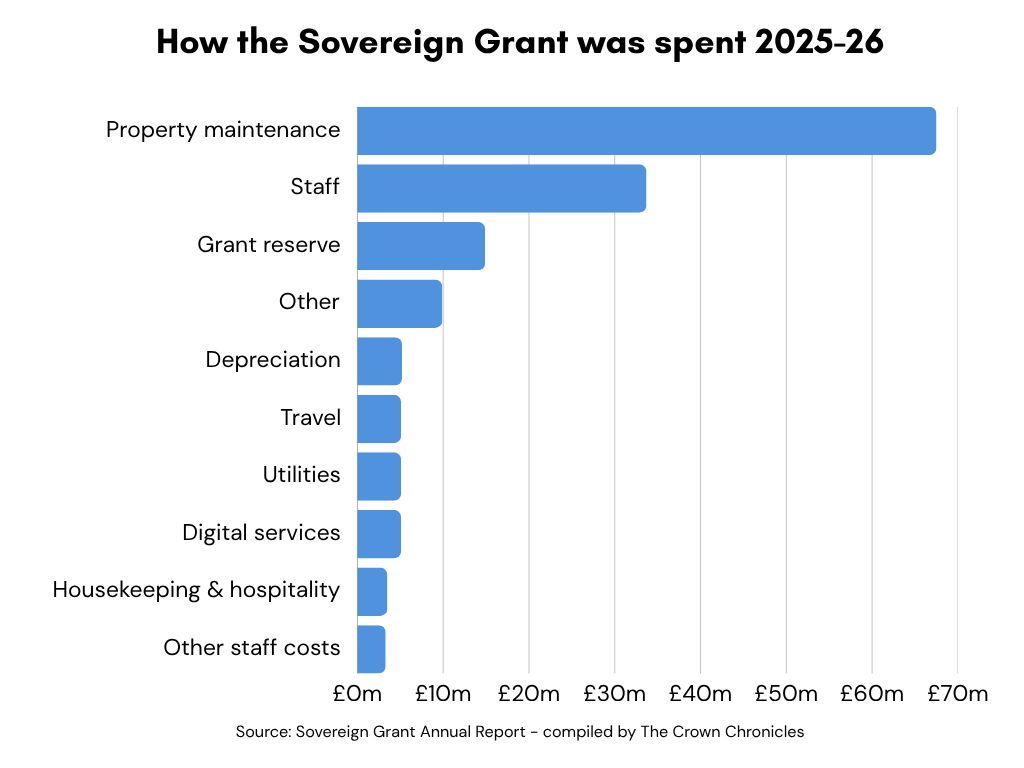 Where the £138.4 million of total expenditure went in 2025-26, with property maintenance dwarfing every other category (chart: The Crown Chronicles, from Sovereign Grant Annual Report figures)
The £72 million core grant means that the upkeep of the Monarchy itself costs each person in the UK £1.02, or including the reservicing costs, £1.91.
How is the money given to the Palace calculated?
The Sovereign Grant is rooted in an arrangement that dates back more than 250 years, when George III handed the revenues of the Crown Estate to the government in 1760 in exchange for a fixed payment, then known as the Civil List.
The Crown Estate itself – a vast portfolio of London property, farmland and almost the entire seabed around England, Wales and Northern Ireland – is run entirely independently, and neither The King nor any other member of the Royal Family has a say in how it is managed, or takes a penny of its profits directly.
When the modern Sovereign Grant replaced the old Civil List in 2012, the payment was pegged to the performance of that estate, calculated as a percentage of its profit from two years earlier. One clause within it guaranteed that the grant can never fall in cash terms from one year to the next.
For 2025-26, that percentage was 12%, having been cut from 25% in the 2023 Royal Trustees’ Review. This is a reduction made deliberately, and at King Charles’ own wish, in anticipation of a coming surge in the estate’s income from offshore wind, but was also to help fund the cost of renovations.
Before this, the figure was 15% of Crown Estate profits.
That surge duly arrived: the Crown Estate posted a record net profit of around £1.1 billion for 2025-26, driven by the boom in leasing the seabed for wind farms, and even at the lower rate of 12%, the bumper result was enough to push the grant up by nearly £46 million. The increase, in other words, reflects how well the estate has been doing rather than any decision by the Palace to ask for more.
What was the Sovereign Grant spent on?
Total operating expenditure from Buckingham Palace for the year came to £138.4 million, up £31.8 million on 2024-25. This was funded by the grant, together with £21.3 million the household earned for itself from renting out venues to hire, the sale of merchandise etc.
It is worth remembering that this money is spent on official work and residences, and not personal expenses, such as rent, clothing and holidays. The Prince and Princess of Wales fund their own lifestyle mostly through the Duchy of Cornwall, which William chooses to pay tax on, while Charles’ personal income is believed to mostly come from the Duchy of Lancaster; again he voluntarily pays tax on this.
For the first time this year, it was revealed exactly how much tax The King and Prince of Wales pay – a total of over £50 million since 2022.
One category if expenditure however towers over all the others.
Property and palaces
At £67.5 million, the upkeep of the ‘Occupied Royal Palaces’ was comfortably the single largest cost of the year, accounting for almost half of everything the Palace spent.
It divides into two distinct streams of work.
The first, and larger, is the Buckingham Palace Reservicing Programme, which absorbed £39.3 million, as engineers continued to replace plumbing, electrical cabling and heating that – in places – had not been touched since shortly after the Second World War.
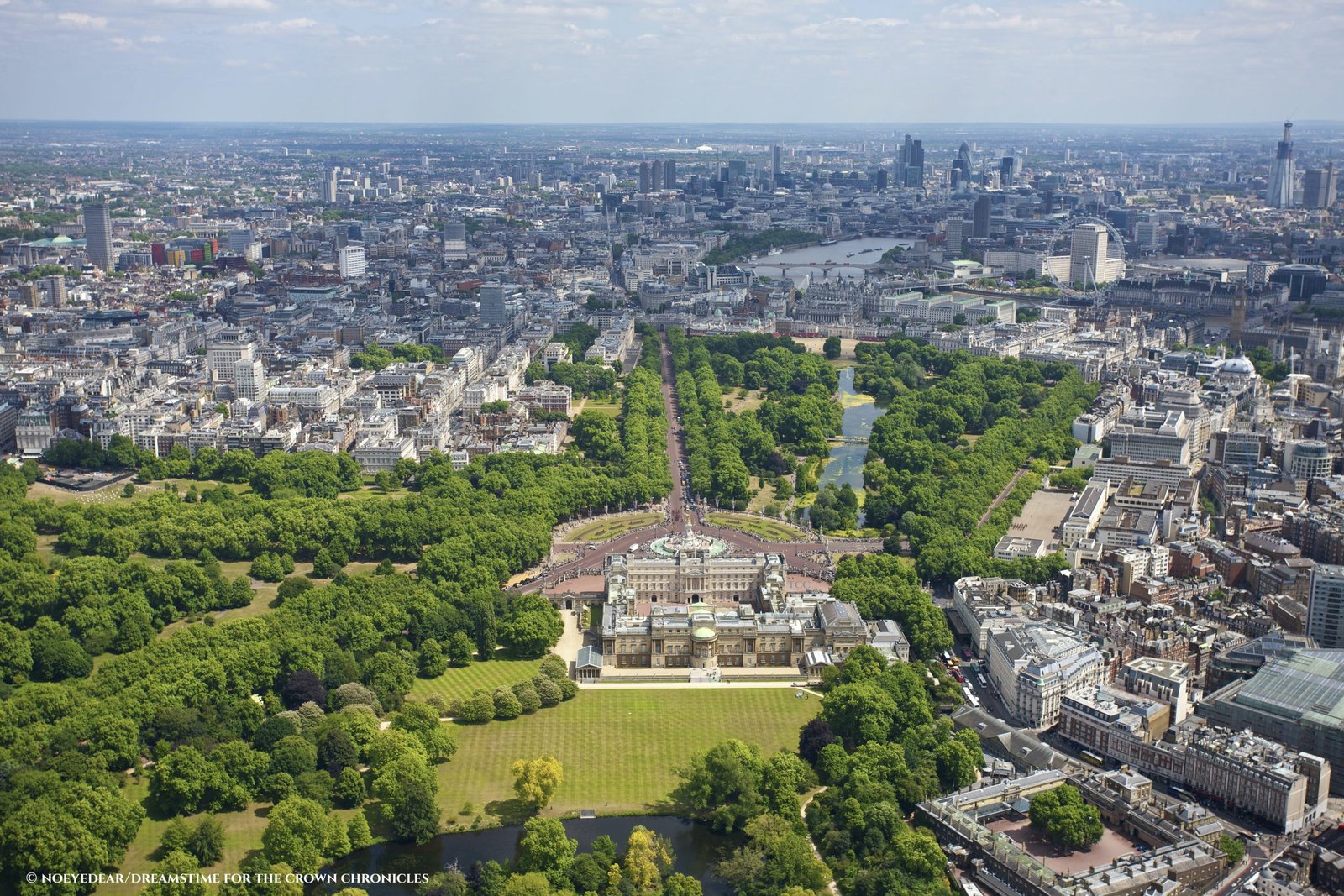
Progress during the year ran a little slower than planned, the report shows, chiefly because workers uncovered more asbestos than expected. But the £369 million programme remains on course to finish by 31 March 2027, by which point two new lifts will have been installed to make the building far more accessible for visitors, staff.
The second stream, worth £28.2 million, covers the rest of the estate, and here the Royal Household made a conscious decision to spend almost £10 million more than the year before. An independent survey carried out during the year found that the proportion of the estate in ‘target condition’ had slipped to 39%, down from 53% in 2020, a decline the report attributes squarely to the three lean years of flat funding between 2021-22 and 2023-24.
Among the major projects spent on were a new South Range roof at Buckingham Palace (costing £926,000), external structural repairs at Kensington Palace (£912,000), roof and air-source heat-pump works in the Lower Ward at Windsor Castle (£634,000, with the old lead melted down and recycled on site), and a relocated, fully-accessible pass office at St James’s Palace (£831,000).
Royal staffing
Payroll and associated costs rose by £3 million to £33.7 million in the last financial year, reflecting a 5% increase in the workforce to an average of 563 full-time-equivalent staff; vacancies that had been left deliberately unfilled during the lean years, were finally filled and targeted roles were added in property, sustainability and procurement.
Staff also received average pay rises of 3%, a figure that takes in the 6.7% jump in the National Living Wage from April 2025, so a busier estate and a more generous wage floor together pushed the bill higher.
Travel
Official travel remains one of the most closely watched lines in the accounts every year, and in 2025-26 it came to £5.1 million within the formal statements, of which the cost of the journeys themselves – the figure most often quoted – was £3.3 million. The remainder was made up of fixed costs, such as the lease on the royal helicopters.

The single most expensive journey of the year belonged to the heir to the throne, Prince William. The most expensive trips were:
- £130,106 – an official Foreign Office visit to Saudi Arabia by The Prince of Wales, his first to the Kingdom, undertaken on behalf of the Government. This included two preparatory visits by Palace staff, during which he met Crown Prince Mohammed bin Salman
- £126,946 – the four-day State Visit to Italy by The King and Queen in April 2025
- £78,542 – The Prince of Wales’ trip to the COP30 climate summit in Belém, Brazil, in November
- £75,371 – the Outward State Visit to the Holy See by Charles and Camilla in October, where The King prayed alongside Pope Leo XIV
- £70,541 – The Duke and Duchess of Edinburgh’s week-long tour of Papua New Guinea and Japan in September.
Beyond the headline five, Princess Anne travelled to Ankara, Turkey (£48,090) and to Kyiv, Ukraine (£28,081), while four journeys by royal train, to Lancaster, Staffordshire, Dartmouth and Clitheroe, cost between £34,109 and £48,460 apiece. These are notable figures, given that the much-loved royal train is due to be decommissioned by 2027 as a cost-saving measure, its contract expiring as the running costs become harder to justify.
The royal helicopters, meanwhile, were used for 177 flights at a total of £733,063, with The Princess Royal the most frequent flyer of all the working Royals.
It is worth remembering, too, that the grant does not pay for everything. The King and Queen’s 2025 visit to Canada for the State Opening of Parliament is recorded at no cost to the Sovereign Grant at all, because travel to the Realms, where The King serves as Head of State, is funded through separate channels.
Entertaining and events
Housekeeping and official hospitality cost £3.5 million across the year, a modest rise on the previous 12 months, and the figure sits behind what was an exceptionally busy diary.
King Charles and Queen Camilla hosted four incoming State Visits, welcoming Presidents Macron of France, Trump of the United States, Steinmeier of Germany and Tinubu of Nigeria, and undertook two of their own, to Italy and the Holy See.

The September State Visit by President Trump was accompanied by what the Government described as the ‘largest commercial package’ in the history of British state visits, worth some £150 billion. More than 30,000 members of the public attended the four Garden Parties, and across the year The King and Queen carried out 708 engagements between them, over a hundred more than the year before.
Bills
The cost of keeping the lights, heating and water running across the palaces actually fell, dropping to £5.1 million thanks to a new renewable energy contract that brought down electricity prices and reduced gas consumption at Buckingham Palace, while the reservicing works were under way. After several years of rising energy bills, that was a welcome reversal, and one the Household credits in part to its own efficiency measures.
Digital, security and other costs
Digital services accounted for £5.1 million, a sum that now includes a dedicated security operations centre set up to strengthen the Household’s defences against cyber attacks.
A further £9.9 million sat under ‘other’ expenditure, covering everything from external audit and professional fees to insurance.
Staying in touch with the public
Beyond the events themselves, the Household’s connection with the public continued to play out both on paper and on screen, and the two moved in opposite directions over the year.
The Royal Family’s social media output grew once again, with more than 2,500 social posts generating 2.1 billion impressions – up from 1.3 billion the year before – alongside 88 million engagements and 432 million views of official videos, a reach the Palace increasingly frames as central to The King’s soft-power role.
The postbag, meanwhile, was lighter than it had been, with the Household receiving 101,669 items of correspondence (vs 123,861 the previous year), a fall the report attributes directly to the receding wave of well-wishes that had followed the cancer diagnoses of The King and The Princess of Wales, which alone accounted for some 41,190 cards and letters in 2024-25. Postage costs totalled £1.5 million.
Health-related correspondence was no longer tracked separately this year, while messages sent to mark milestone birthdays and anniversaries on Their Majesties’ behalf rose to 53,483.
How the Palace topped up the grant
The Household does not rely on the grant alone. Supplementary income of £21.3 million came in over the year, very slightly down on the previous total, the bulk of it generated through the facilities management charge paid by the Royal Collection Trust, off the back of strong visitor numbers at Buckingham Palace, alongside rental income and charges for functions held on behalf of others.
In the next financial year, I expect to see this figure remain strong or even grow, given the new exhibition on the late Queen’s wardrobe that has proven immensely popular.
Embed from Getty Images
Embed from Getty Images
The back-up funds
Among the quieter figures in the report, the Sovereign Grant Reserve is one of the most telling. This year it more than doubled, climbing from £8.3 million to £21.2 million after a transfer of £14.9 million – set against a transfer of just £1.1 million the year before.
These are the funds the Palace can fall back on when unexpected costs arise, held on its behalf by the Exchequer, and most of this year’s surplus exists for a very practical reason: the reservicing money arrives in tranches that do not line up neatly with when the builders’ invoices land, so some £14.7 million of the reserve has effectively been set aside to meet future commitments on the Palace works, which still total £52.6 million under contract. Should the asbestos discoveries or any other surprise push the programme over budget, the report makes clear that the shortfall would be met from this reserve.
There is a sensible limit built into the system, all the same. If the reserve ever climbs above 50% of the year’s net expenditure, the Royal Trustees are entitled to dock the following year’s grant accordingly, and at 31 March 2026 the reserve stood at 18%, comfortably within bounds, so it neither triggers a reduction nor breaches the rules that govern it.
What next? The grant after Buckingham Palace
This record grant is best understood as a peak that the accounts have been climbing towards for years, and the descent is already mapped out. The grant rises once more in 2026-27, to £137.9 million, delivering the final tranche of money for Buckingham Palace works, and then, from 2027-28, it falls for the first time since the Sovereign Grant was created.
The Royal Trustees confirmed on 25 June that the grant will drop to just under £100 million a year for the five years from 2027 until 2032, with the core grant set at £99.9 million once the separate funding for the Palace works falls away.
Behind that headline reduction sits a subtler shift: the percentage of Crown Estate profits used in the calculation will actually rise, from 12% to 20.5%, precisely because those profits are expected to shrink as the lucrative offshore wind option fees come to an end – the estate’s net profit has already fallen back to £487 million.
The new core grant, while lower than the temporarily-inflated totals of these final Palace years, is still almost double the £51.8 million core grant of 2024-25, and the Household has earmarked the extra headroom for a backlog of maintenance across the residences, stronger cyber security, and energy-efficient heating, with £11 million alone going towards replacing the aging boilers at Windsor Castle.
The report also lands in a week that has seen the Palace push further towards transparency than ever before, with The King revealing his personal tax bill for the first time, declaring £12.9 million paid in 2024-25 and drawing a clearer line between the public grant and the private income he draws from the Duchy of Lancaster.
Not everyone is persuaded, however. The campaign group Republic, which argues for an elected head of state and the abolition of the Monarchy, called the royal finances ‘out of control’ and maintains that the true cost of the Monarchy – once security and forgone revenues are added in – runs to well over £500 million a year. This is a figure the Palace does not recognise, but one that ensures the debate over value for money will rumble on, particularly in a time when there are people in the UK who are struggling to pay their own bills.
Comment from the Palace
James Chalmers, Keeper of the Privy Purse and Treasurer to The King, was keen to stress where the money does and does not go, telling reporters that the grant ‘funds the work of the institution – not private lives or private wealth’, and rejecting any suggestion that the Household enjoys a blank cheque.
Expenditure, he said, is governed by the same standards and disciplines as any publicly funded body’, with strict value-for-money requirements, multi-year planning, independent audit and Treasury oversight.
For all the noise that a 53% rise inevitably generates, the story these accounts tell is a fairly orderly one – a nationally-important, historic building being put right after decades of neglect, a workforce restored to strength as demand grows, and a grant that has already been set on a downward path for the years to come.
Whether £100 million a year reads as restraint or excess will, as ever, depend rather less on the figures themselves than on how the public chooses to feel about the institution they pay for.