Home » The Line of Succession – who’s next, why, and the rules that decide it
The Line of Succession to the British throne follows the descendants of Charles III, followed by his cousins. This list takes us just past the first 60 in line, ending wiht the late Queen’s cousins.
There is no official, complete list of the line of succession, and no Palace document sets it out.
Instead, the order is worked out from laws passed by Parliament over more than three centuries, applied to one family tree – that of the House of Windsor. That’s why it sometimes produces surprises: a younger sister placed ahead of her brother in one household and behind him in the next, a former Prince still eighth in line after losing his title, and a baby born in Portugal who took her place in the line on the day she was born.
This page explains how it all works, answers the questions readers ask us most often, and sets out the line in full.
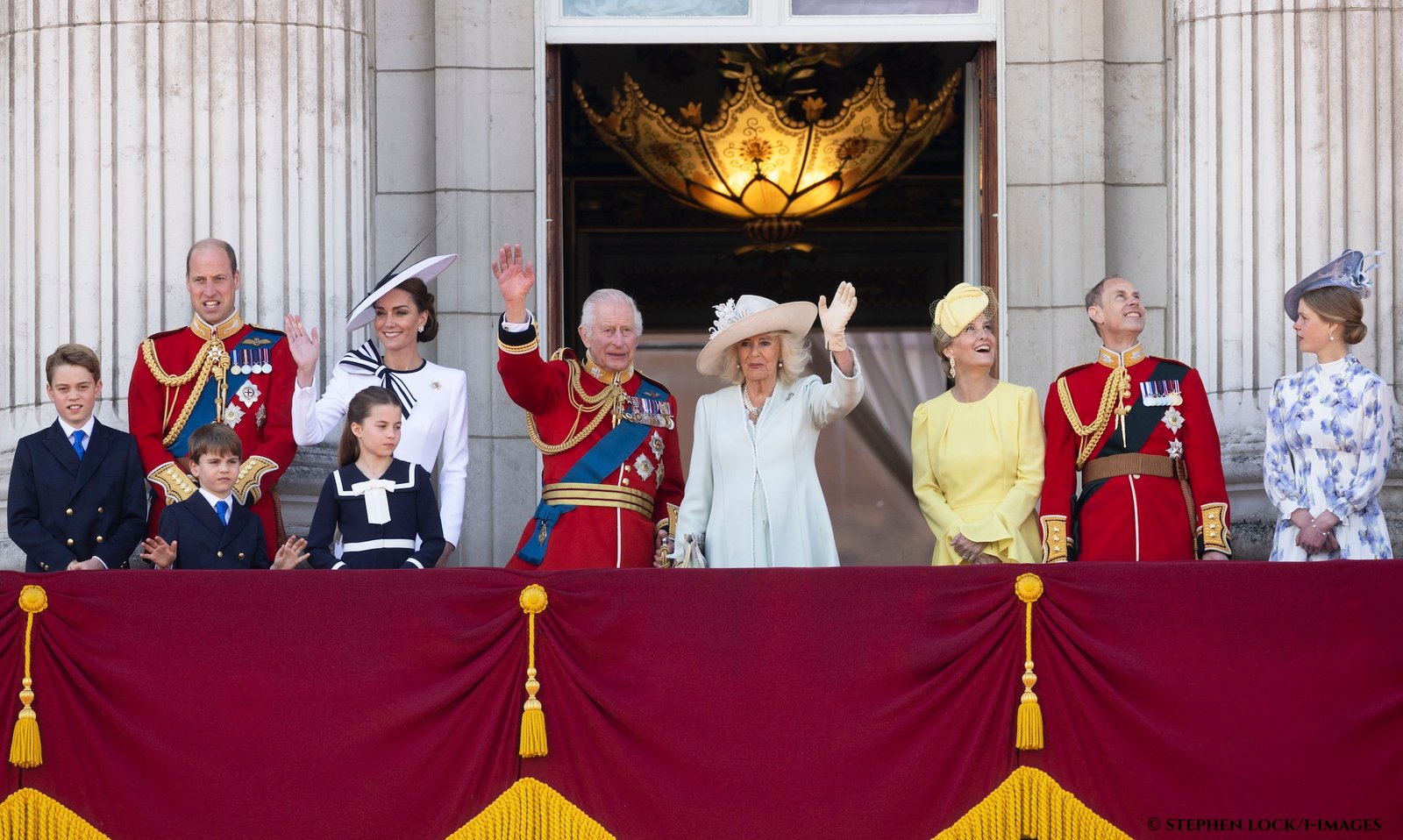
The Prince of Wales is heir to the throne, followed by his three children: Prince George, Princess Charlotte, and Prince Louis.
After them come Prince Harry, The Duke of Sussex, and his two children, then The King’s younger brother, Andrew Mountbatten-Windsor, and his descendants.
The full order is set out at the bottom of this page.
The heir becomes Sovereign immediately, which is the meaning of the old proclamation ‘The King is dead, long live the King’. There is no gap, and no ceremony is needed for the new reign to begin.
Parliament does, not The King.
The Crown passes according to the law, and the most important of those laws date from a period when the throne was at the centre of a religious and political crisis.
The Bill of Rights of 1689 was passed after the Catholic King James II was replaced by his Protestant daughter Mary and her husband William of Orange. The Act barred Catholics from the throne.
Then, in 1700, Queen Anne’s last surviving child, Prince William, Duke of Gloucester, died aged 11, and Parliament faced the prospect of the Crown passing to a Catholic relative… Its answer was the Act of Settlement of 1701, which settled the throne on Sophia, Electress of Hanover, a granddaughter of King James VI and I, and on her Protestant descendants.
Dozens of Catholic relatives with a closer blood claim were passed over to protect the Church of England.
Sophia never wore the Crown: she died on 8th June 1714, less than two months before Queen Anne, and so it was her son who became King George I.
Every Sovereign since has descended from her, and the rule still applies: to be included in the line today, you must be a descendant of Sophia and not a Catholic. The Union with Scotland in 1707 confirmed the same succession for the new Kingdom of Great Britain.
For most of British history, the Crown passed by order of male-preference primogeniture: the eldest son inherited, and daughters came after all their brothers, whatever their age.
That’s how Princess Anne, born in 1950, came to sit behind her younger brothers, Andrew and Edward.
In 2011, at the Commonwealth Heads of Government Meeting in Perth, Australia, the leaders of all 16 realms (who have the same Monarch as here in the UK) agreed to change this. Because the King is also King of Canada, Australia, New Zealand, and the other realms, they must all share the same line, so every one of them had to pass its own legislation.
In the UK this became the Succession to the Crown Act 2013, and the changes came into force across the realms on 26th March 2015. (There are now 15 realms, as Barbados became a republic in 2021.)
The change applies only to people born after 28th October 2011, the date of the Perth Agreement. P
rincess Charlotte, born in 2015, therefore keeps her place ahead of her younger brother, Prince Louis.
But the old rule still governs anyone born before that date – which is why James, Earl of Wessex (born 2007) sits ahead of his older sister, Lady Louise Mountbatten-Windsor (born 2003).
The cut-off even runs through single families: Lady Davina Lewis’s daughter Senna, born in 2010, sits ahead of her younger brother Tāne, born in 2012, because his later birth date meant his sex no longer gave him precedence.
The Sovereign is Supreme Governor of the Church of England, and the law requires them to be ‘in communion’ with it, meaning a practising member. Catholics of course have their own set of rules and beliefs which would conflict with the Anglican faith.
On accession, the new Sovereign also swears to maintain the Church of Scotland, and makes a declaration that they are a faithful Protestant.
What has changed is marriage: until 2015, anyone in the line who married a Catholic lost their place in the line of succession. The 2013 Act removed that rule, and did so retrospectively, so Prince Michael of Kent (who married a Catholic in 1978) and his nephew, the Earl of St Andrews (who did the same in 1988), were both restored to the line.
Being a Catholic still excludes a person, however, which is why several members of the Kent family, who converted, do not appear in the list below.
This also changed with the 2013 Act, meaning that only the first six people in line need the Monarch’s permission to marry. Today, that means the Prince of Wales, his three children, Prince Harry, and Prince Archie.
Before this, under the Royal Marriages Act of 1772, passed by George III after two of his brothers made marriages he disapproved of, almost every descendant of George II needed royal consent to marry.
No, the line is set by law so the King cannot choose to pass over The Prince of Wales in favour of Prince George, or anyone else. The only way to alter the order is an Act of Parliament, agreed by all the 15 realms.
An abdication would also need legislation.
When Edward VIII gave up the throne on 11th December 1936, Parliament passed an Act the same day which removed both him and any future descendants from the line.
The King stripped his brother of his titles and honours, not his position, which we know he cannot do without Parliament, nor the support of the other realms where he is King.
Being a working Royal is a role, not a legal status.
The Duke of Sussex stepped back from royal duties in 2020, but his place in the line, fifth, is set by his birth, and only Parliament could change it. The same applies to his children, Prince Archie and Princess Lilibet.
They may not support the Crown with work, but are still part and parcel of the system.
Yes, but only by an Act of Parliament, with the agreement of the other realms. It has happened only once, in 1936.
The question has been raised again over Andrew Mountbatten-Windsor. The King removed his brother’s titles, including that of Prince, in October 2025, but that did not affect his place as eighth in line, because titles are within the Sovereign’s gift and the succession is not.
In February 2026, following Andrew’s arrest on suspicion of misconduct in public office (he denies any wrongdoing), the UK government said it would consider legislation to remove him from the line once the police investigation had concluded. The governments of Australia and New Zealand said they would support such a move. Whether any change would also affect his daughters and their children would depend on how the legislation was written – but given they are not part of the legal issues raised, and they meet all other criteria to be included, it seems unlikely they would be removed too.
The heir becomes Sovereign immediately, which is the meaning of the old proclamation ‘The King is dead, long live the King’. There is no gap, and no ceremony is needed for the new reign to begin.
The formalities follow. The Accession Council, made up mainly of Privy Counsellors (senior politicians and officials who advise the Sovereign), meets at St James’s Palace to proclaim the new Sovereign, and it is there that the oath to maintain the Church of Scotland is taken.
King Charles III’s Accession Council met on 10th September 2022, two days after the death of the late Queen, and was televised for the first time. The coronation, a religious service rather than a legal requirement, often comes much later: The King’s was on 6th May 2023.
If a Sovereign comes to the throne under the age of 18, a Regent rules on their behalf, under the Regency Acts. The Regent would normally be the next adult in line who meets the legal requirements, though Parliament can make other arrangements, as it did in 1953, when it named Prince Philip as Regent should the young Prince Charles have succeeded as a child.
Related, but separate, are Counsellors of State, who can carry out some of the Sovereign’s duties when he is abroad or unwell. They are the Sovereign’s spouse and the next four adults in line, and the Counsellors of State Act 2022 added The Duke of Edinburgh and The Princess Royal, so that working Royals would always be available.
The descendants of the late Queen’s uncle, Prince George, Duke of Kent
Not included: Lord Nicholas Windsor, the Duke of Kent’s younger son, and his children; and the Earl of St Andrews’ son, Lord Downpatrick, and daughter, Lady Marina Windsor, all of whom are Catholic.