
On paper, The King’s powers are considerable. He appoints the Prime Minister, opens and dissolves Parliament, turns bills into law and commands the Armed Forces, and every government minister serves in his name.
‘The Crown’ is a legal term for the state and its government, which acts in the Sovereign’s name. That is why the name runs through public life: taxes are collected by His Majesty’s Revenue and Customs, prosecutions are brought by the Crown Prosecution Service, senior barristers become King’s Counsel (formerly Queen’s Counsel), and The King’s image appears on coins and stamps.
None of this means The King runs these bodies himself – it means they exercise authority that, in law, flows from the Crown.
In practice, almost all of these powers are used on the advice of elected ministers, and the reasons for that arrangement go back through nearly four centuries of British history.
Understanding the gap between what the Sovereign can do in law and what he does do in practice is the key to understanding the modern Monarchy.
This explainer sets out the powers that remain, how each one works, and where The King’s personal involvement begins and ends…
Powers The King exercises himself, on advice
The King appoints the person most likely to command the confidence of the House of Commons as Prime Minister, usually the leader of the political party that wins a general election.
The appointment takes place at a private audience known formally as ‘kissing hands’, although today it is marked with a handshake instead.
The ceremony is brief, but it is historically important.
On 6th September 2022, Elizabeth II appointed Liz Truss to the office of Prime Minister at Balmoral, in what proved to be her final constitutional act, just two days before her death.
The King has since appointed two Prime Ministers: Rishi Sunak on 25th October 2022, Sir Keir Starmer on 5th July 2024, and Andy Burnham on 20th July 2026.
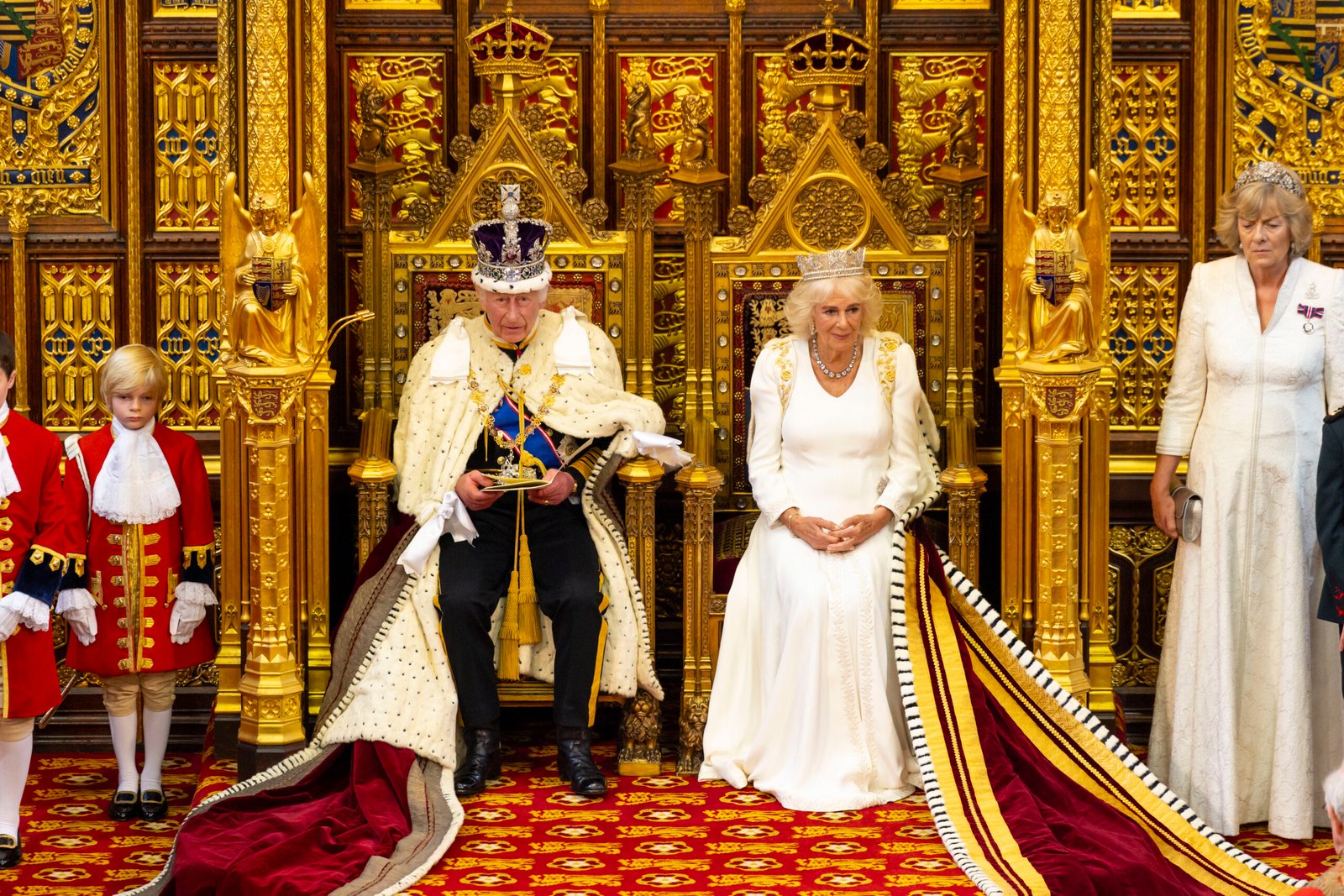
The King formally opens each new session of Parliament at the State Opening.
He reads the King’s Speech from the throne in the House of Lords. The speech sets out the government’s plans for new laws, policies and their broader agenda for the next session. So although The King delivers it, the government writes it, and he has no influence over the contents.
The Sovereign does not enter the House of Commons, a convention dating back to January 1642, when Charles I entered the chamber with soldiers to arrest five MPs.
This is why Black Rod, a senior officer of the House of Lords, summons Members of Parliament (MPs) to hear the speech innthe Lords, and why the Commons door is ceremonially shut in his face before he is admitted.
At the end of a session, which usually lasts around XX months, Parliament is prorogued (formally closed) until the next session begins.
Before a general election, Parliament is dissolved. Both happen by The King’s authority at the Prime Minister’s request.
The power to dissolve Parliament was briefly replaced by the Fixed-term Parliaments Act 2011, and it was restored to the Crown by the Dissolution and Calling of Parliament Act 2022.
No bill becomes law until it receives Royal Assent, the Sovereign’s formal agreement to a bill passed by both Houses of Parliament.
It is the final stage in the process, and the moment an Act enters the statute book.
Assent is announced in each House using a Norman French formula, Le Roy le veult (‘The King wills it’), a phrase which has survived since the medieval period.
No Sovereign has given Royal Assent in person since Queen Victoria in 1854, when she personally assented to five acts of Parliament on 12 August, including a customs act fixing the import duty on rum.
Today it is normally granted by Letters Patent – a formal written instrument – under the Royal Assent Act 1967.
By law, the Sovereign could technically refuse to give royal assent, though the last Monarch to do so was Queen Anne, who withheld assent from the Scottish Militia Bill in 1708.
The bill proposed creating an armed local military force in Scotland, which was passed in both the Commons and the Lords; however, a French fleet carrying Jacobites was spotted so ministerial advice gave to the Queen recommended she did not give her assent.
Royal Assent has been granted to every bill since.
Royal Assent should not be confused with King’s Consent: King’s Consent is a separate step, required before Parliament debates a bill that would affect the prerogative or the Crown’s own interests, such as the Duchies of Lancaster and Cornwall. It too is given on ministerial advice.
The King formally appoints judges, ambassadors, senior military officers, and the Archbishops and Bishops of the Church of England, 26 of whom sit in the House of Lords.
He also creates new peers, meaning members of the House of Lords (the upper chamber), and approves the election of the Speaker of the House of Commons and the Lord Speaker.
All of these appointments are made on advice, and the approvals are, in practice, a formality.
Many decisions are formalised through the Privy Council, a body of senior politicians, judges and officials that advises the Sovereign.
Government decisions that do not need an Act of Parliament are approved as Orders in Council at regular meetings with The King. By long tradition, everyone at these meetings stands, including The King.
The Privy Council also meets as the Accession Council when a new Monarch comes to the throne.
On 10th September 2022, the Accession Council formally proclaimed The King’s accession at St James’s Palace. It was the first time the ceremony had been televised.
Powers ministers use in the Crown's name
Many prerogative powers are now exercised directly by government ministers, even though they remain the Crown’s in law. These include:
- declaring war and deploying the Armed Forces
- making and ratifying treaties
- recognising foreign states
- issuing passports
- granting pardons, through what is known as the prerogative of mercy
The Sovereign plays no personal part in most of these decisions. Ministers take them, and ministers answer to Parliament for them.
Where did these powers come from?
The Crown’s remaining powers are known as the ‘royal prerogative’. This is the authority that once belonged to the Sovereign alone and has never been fully replaced by Acts of Parliament.
In the medieval period, Monarchs waged war, raised armies, appointed and dismissed their advisers, and summoned Parliament largely when they needed money.
The balance shifted decisively in the 17th century. Charles I’s conflict with Parliament led to civil war and his execution in 1649, and the Monarchy was restored under Charles II in 1660 – but the question of whether the Crown or Parliament held ultimate authority was not settled until 1689.
That year, the Bill of Rights confirmed that the Crown could not raise taxes, suspend laws or keep a standing army in peacetime without Parliament’s consent.
Since then, most prerogative powers have either been replaced by legislation or passed, in practice, to ministers. Those that remain are governed by constitutional conventions: unwritten rules that are not enforced by the courts, but are observed so consistently that they carry almost the same weight as law.