
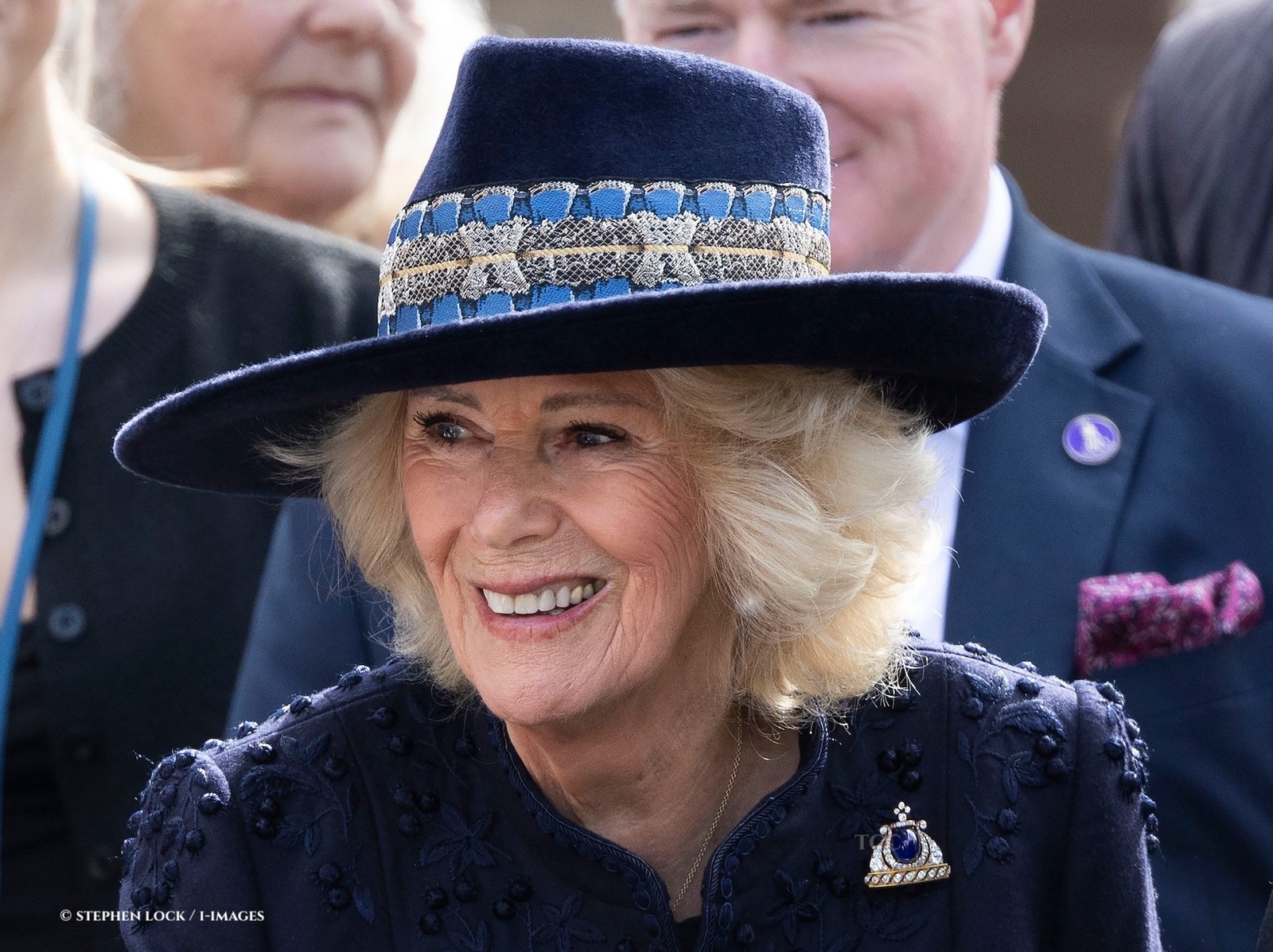
The Queen has been an advocate for osteoporosis awareness for decades, stemming from her own personal experience with the condition.
The cause is a deeply personal one: osteoporosis led to the deaths of both her mother and her grandmother, and over 30 years, Camilla has gone from private supporter to the charity’s President and one of its most visible voices.
What is osteoporosis?
Osteoporosis is a condition that weakens bones, making them fragile and more likely to break. It develops slowly over time and is often only diagnosed after a fall causes a broken bone – but a break can be caused by something as simple as a sneeze or a cough.
According to the ROS, around one in two women over the age of 50, and one in five men, will break a bone because of osteoporosis.
The fractures are painful, can be debilitating, and are sometimes even fatal. Some people with osteoporosis develop a bent posture, which happens when bones in the spine break.
A family story
Camilla’s experience of osteoporosis is a family one, as both her mother and her grandmother suffered from it. Her mother, Rosalind Shand, died in 1994, aged 72, as a result of the disease.
The Queen has spoken publicly about her mother’s illness, sharing that it caused her to lose eight inches in height and to suffer broken bones from minimal contact. Camilla’s maternal grandmother, Sonia Keppel, had died eight years earlier, in 1986, also as a result of the disease.
Speaking at the charity’s 40th anniversary reception at Clarence House, The King and Queen’s London residence, in July this year, Camilla said: ‘In those bad old days, osteoporosis was seldom discussed, rarely diagnosed and usually attributed to old women with so-called “Dowagers’ humps.” My family and I had little, or no, understanding of this devastating disease and were determined to discover more about it.’
A ‘Dowager’s hump’ is the curve in the upper spine caused by fractures in the vertebrae, with the term dowager meaning a widow and later becoming simply associated with an older woman.
It was after her mother’s death that Camilla became a supporter of the charity, then known as the National Osteoporosis Society. It had been founded in Somerset in 1986 by Professor Allan Dixon and Linda Edwards, and Camilla has recalled discovering it, then a tiny organisation, close to where she lived at the time.
At an ROS reception at Clarence House in October 2024, The Queen spoke again of her mother: ‘My mother died of osteoporosis, not of the actual disease, it was never diagnosed in those days and old people were just cast aside as old people, you know, “sorry we can’t do anything about it”.
‘Had she lived nowadays a lot would have been done about it.’
Her point was that the disease itself was never diagnosed: her mother died of its complications, at a time when doctors attributed the symptoms to old age.
From supporter to President
The Royal Osteoporosis Society (ROS) describes itself as the UK’s largest national charity dedicated to improving bone health and beating osteoporosis. Its vision is ‘no more broken bones, no more broken lives.’
The charity runs support groups throughout the UK for people living with the disease. Two of its main goals are supporting people to live well with osteoporosis, and achieving quicker diagnosis and better ongoing care wherever people live. It also funds research into the condition and promotes awareness of its existence and its risks.
Camilla became the charity’s Patron in 1997 and its President in 2001, both before her marriage to the then Prince of Wales, in 2005, though she was affiliated with them since 1994. Many royal patronages pass from one member of the family to another; this was a cause she chose for herself as a private individual.
The cause was one of her first official engagements after her marriage, bringing more attention to the charity: the newlywed visited the Osteoporosis Centre at Southampton General Hospital in May 2005 for her first official solo engagement.
Embed from Getty Images Embed from Getty Images
Since then, she has used her position to keep the disease in public view, hosting the charity’s supporters at Clarence House, visiting hospitals and meeting patients, and returning to her mother’s story in speech after speech.
In 2007, Camilla received the Kohn Foundation Award from Dr Ralph Kohn (later Sir Ralph Kohn), in recognition of her contribution to raising awareness of the condition.
The same year, she was also given an Honorary Fellowship from King’s College London in recognition of her work to raise awareness of osteoporosis.
This was also what we believe to be the first appearance of Camilla’s osteoporosis brooch, coinciding with her 10-year formal affiliation with the charity. She wore it often it to related engagements, and it is based on the charity’s old, round logo, since replaced.
In 2019, after 18 years with Camilla as its President, the charity was granted its royal title by Elizabeth II and relaunched as the Royal Osteoporosis Society (ROS).
In January 2023, now as Queen Consort, Camilla opened the charity’s new city centre offices in Bath. The ROS links its home to the city’s medical history: Bath’s thermal spa helped shape rheumatology, the branch of medicine concerned with joints, muscles and bones, as a distinct specialty.
Putting bone health on the map
In October 2022, Camilla helped launch the ROS’s online Risk Checker. On World Osteoporosis Day 2025, the charity followed it with the Great British Bone Check – a free three-minute online questionnaire, backed by The Queen, that helps people spot the signs and risks of the disease. It aims to risk-check three million people. More than 500,000 checks were completed in its first week.
The Queen’s Award for Osteoporosis, formerly the Duchess of Cornwall Award, is usually presented at the charity’s reception at Clarence House.
The award was created in 2009 and renamed after Camilla’s change of title. It was first presented under its new name in October 2024, to Dr Nicola Peel, a consultant whose work has improved how people at risk of fractures are assessed.
Dr Peel credited Camilla’s personal connection to the cause as hugely important to the charity’s work in raising awareness.
The 2026 recipient was art dealer Ivor Braka, recognised for over 20 years of philanthropy, advocacy and event hosting, and for raising over £1.5m for the charity.
To mark its 40th anniversary in 2026, the charity invited supporters to take on a personal fundraising challenge inspired by the number 40. The challenge can be anything, big or small, from walking 40 miles to baking 40 cakes. The challenge runs from June – December 2026.
In 2021, the ROS published a study into the lives of people with the condition. Its previous CEO, Craig Jones, said that Camilla’s support had been ‘our greatest asset in raising awareness of the importance of preventing and treating osteoporosis, since she has seen its impact first-hand in her own family.’
Prevention and the next generation
In an interview with broadcaster Gloria Hunniford on BBC One’s Morning Live to mark World Osteoporosis Day in 2021, the Royal reflected on her personal experience.
She recalled that a hug from a friend had broken her mother’s rib, and spoke about preventing the disease: ‘You have to prevent it by taking a look at yourself and saying look I don’t want to have this disease so you must take a lot of exercise, walking in particular is the best thing.’

Her message is aimed at younger generations too, because osteoporosis is not only an illness of old age. In the same interview, she said: ‘I’d love to see more young people understanding about it, not just thinking you know poor old bats we’re going to get old and that’s what’s going to happen to us.’
A silent thief hiding in plain sight’
The Queen regularly hosts the charity’s supporters, trustees, and patrons at Clarence House. At the 40th anniversary reception in July 2026, held in the gardens, she described osteoporosis as a ‘silent thief hiding in plain sight.’
She added: ‘Without being aware of it, our bones have lost their density and strength until suddenly, a simple everyday act – picking up a grandchild, slipping over or even sneezing – turns into a life-altering event as our bones shatter.’
She ended her speech on a note of hope: ‘Together, we can – and we will – see the end of osteoporosis, forever.’